Faces Before Footsteps: Reading the Horse’s Expression Without Turning It Into Training
The Face as Weather, Not a Verdict
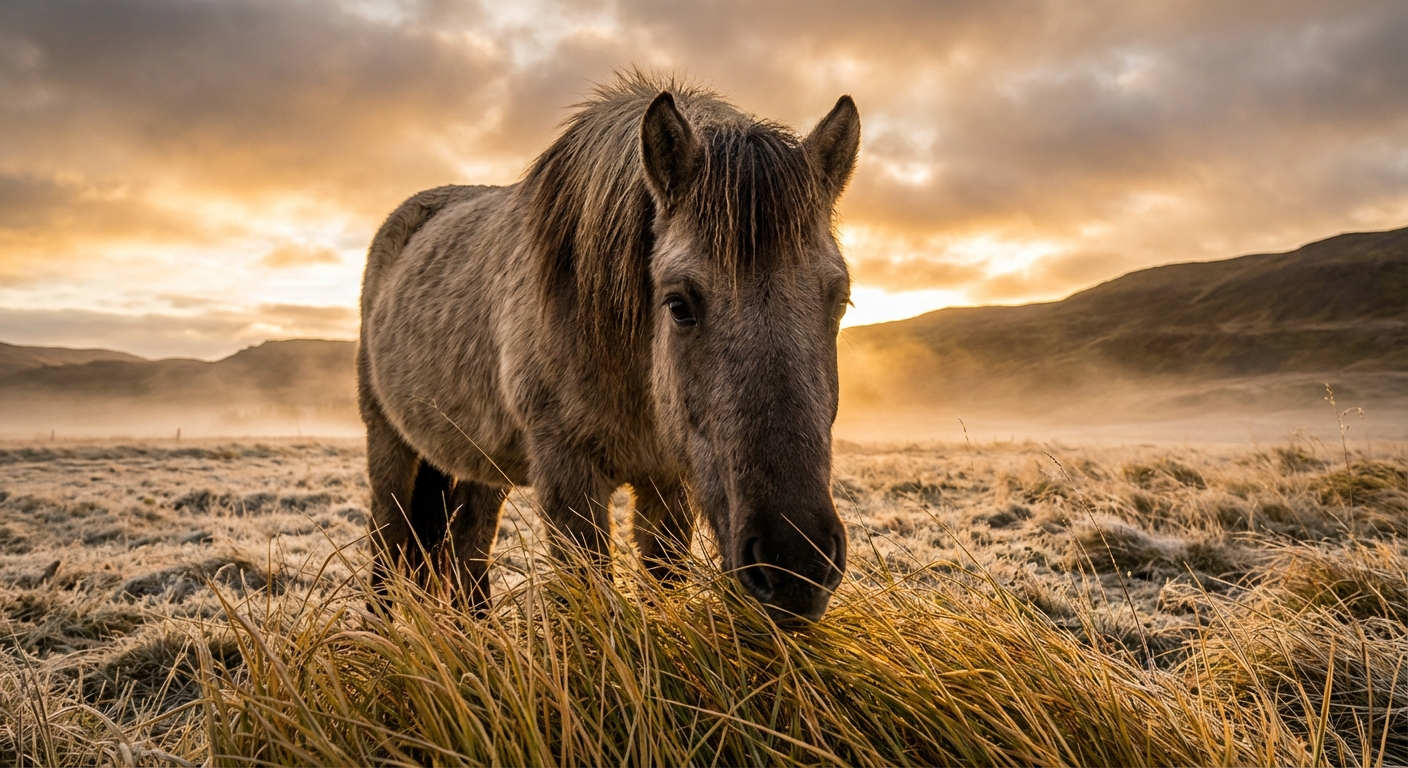
Before a horse moves a single hoof or swishes their tail, my attention is drawn first to the face.
This isn't because I'm searching for some revealing signal, nor because I wish to prevail in some subtle battle for dominance. It's simply that the face tends to be where the body's inner climate reveals itself earliest—particularly when we stand together without equipment, without purpose, and without any need for pretense on either side.
We're easily drawn to treat reading expressions as rendering judgment: at ease or tense, welcoming or guarded, trustworthy or not. Yet horses do not exist as frozen moments in time. What we perceive as "expression" is actually part of an ongoing dialogue between the horse, their surroundings, and those who share their space.
Within a herd, harmony is rarely maintained through perpetual conflict. Much of the peace emerges from each member learning when to give way, when to pause, when to draw near, or when to withdraw—all depending on the circumstances and what's at stake. That same fluid responsiveness is inscribed upon the face for those patient enough to observe. A horse appearing relaxed and open beside one companion may seem guarded and alert beside another. This doesn't brand the horse as inherently "dominant" or "submissive." It reveals them as adaptive—attuned to their circumstances.
When we arrive at the pasture carrying a fixed narrative, we frequently overlook what the horse is already engaged in: adapting. In our own lives, we might ask whether we grant the same grace to the people around us—or whether we too often mistake a momentary expression for a permanent verdict about who someone is.
EquiFACS as a Humility Practice
A structured system like EquiFACS might initially seem antithetical to coexistence: categorizing, naming, dissecting. Yet the true offering of any rigorous observation practice is not certainty—it is humility.
The invitation is not "I can interpret my horse completely." The invitation is "I can become still enough to truly see." This kind of seeing prevents us from imposing our own storylines onto a horse's countenance. It guards us from confusing our own unease with their disposition.
Horses perceive our inner landscape. Countless observers have witnessed this: enter a paddock with a scattered mind and rigid shoulders, and the horse maintains distance, observing. Arrive quietly, let your gaze soften, breathe slowly, and the horse becomes more inclined to approach. This acute sensitivity transforms what we believe we're perceiving in their face, because our very presence constitutes part of the environment to which their face responds.
Thus, reading expression begins with an unspoken inquiry we direct inward: what am I carrying into this space? This question extends far beyond the paddock—it is the foundation of any authentic encounter, whether with animals or with other human beings.
Synchronization: When Two Faces Start to Match
There exists a phenomenon almost too subtle to name in a culture fixated on methods and techniques: synchronization.
When someone walks peacefully beside a horse, breath and stride can gradually fall into rhythm. The horse mirrors the human's pace, while the human unconsciously mirrors the horse's. This is not mysticism. It is a wordless exchange that unfolds when neither being attempts to impose a predetermined outcome upon the other.
Within such stillness, the horse's face can transform before your eyes—not as performance, but as release. And your own face transforms as well. The jaw loosens. The eyes cease their restless scanning. The way you look at the horse shifts from something like a searchlight to something more like an open door.
For those drawn to understanding facial expression, coexistence provides an unexpectedly useful guideline: refrain from staring with predatory intensity, and refrain from watching with the scrutiny of a judge. Simply be present like the weather—steady, transparent, reliable. Perhaps our deepest human connections also await this same quality of presence—neither grasping nor evaluating, but simply being alongside another.
Coherence Over Control
Horses are not seeking a commander to issue directives. They seek coherence—a calm, clear, consistent presence emanating from within. In their reality, coherence communicates safety.
This is significant because many human interpretive errors arise from rushing toward conclusions: "He's being aggressive." "She's being defiant." These are human moral frameworks superimposed upon a creature whose daily existence involves negotiating space, access, and comfort while minimizing danger.
When we orient ourselves toward coherence, the encounter becomes more straightforward. We observe the horse's expression without requiring it to justify itself. We register shifts without amplifying them into crisis. We allow the horse to retreat without feeling rejected, and we allow them to draw near without claiming it as a victory.
This is what coexistence means: not demanding that the horse demonstrate tranquility, but cultivating an environment serene enough that tranquility can naturally emerge. The same principle illuminates our human relationships—we cannot force peace in others, but we can become the kind of presence that makes peace possible.
A Field Notebook With No Scores
If you seek a practice that remains outside the realm of training, consider this: let your observations be purely descriptive and provisional.
Not "hostile." Not "gentle." Not "bossy."
Rather: "Observing." "Withdrawing." "Drawing near." "Releasing tension." "Remaining motionless." "Trailing at a distance."
Then include the overlooked portion of the scene: what was unfolding in the surroundings—and within yourself. Were you rushed? Were other horses present? Was there rivalry over food? Were you standing with clenched shoulders or an easeful stance?
With time, you will cultivate something far more valuable than any label: an honest relationship with what is actually happening. And this is the true purpose of reading facial expressions within a life of coexistence—not to master the horse, but to become a more grounded presence within the horse's world. In learning to witness another being without the compulsion to name and control, we may discover we've also learned something essential about witnessing ourselves.
Equine Notion
https://equinenotion.com/