The Fence That Makes Humans Small: Why Horses Settle Through Felt Safety, Not Buildings
Hook
The most peculiar aspect of our property has nothing to do with where the horses reside.
It concerns what we choose to do.
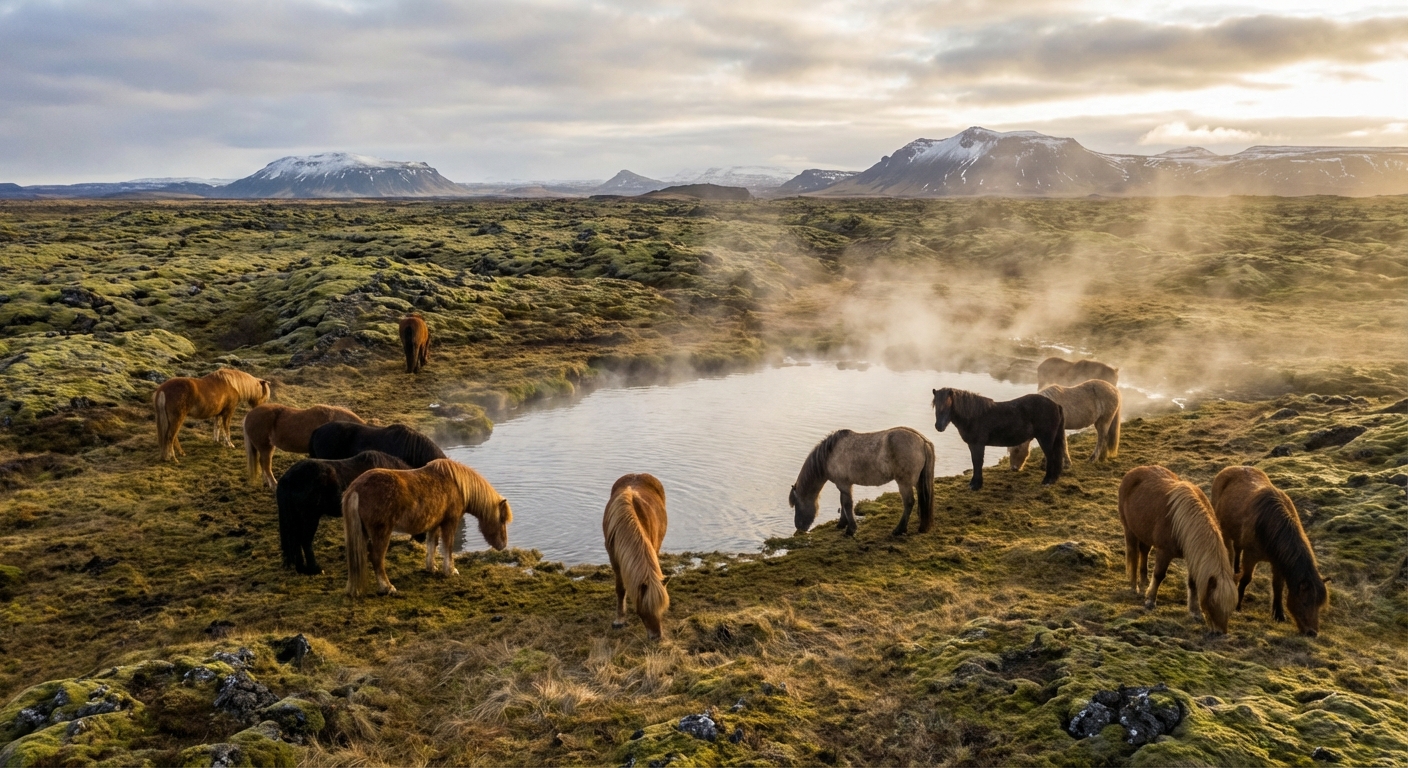
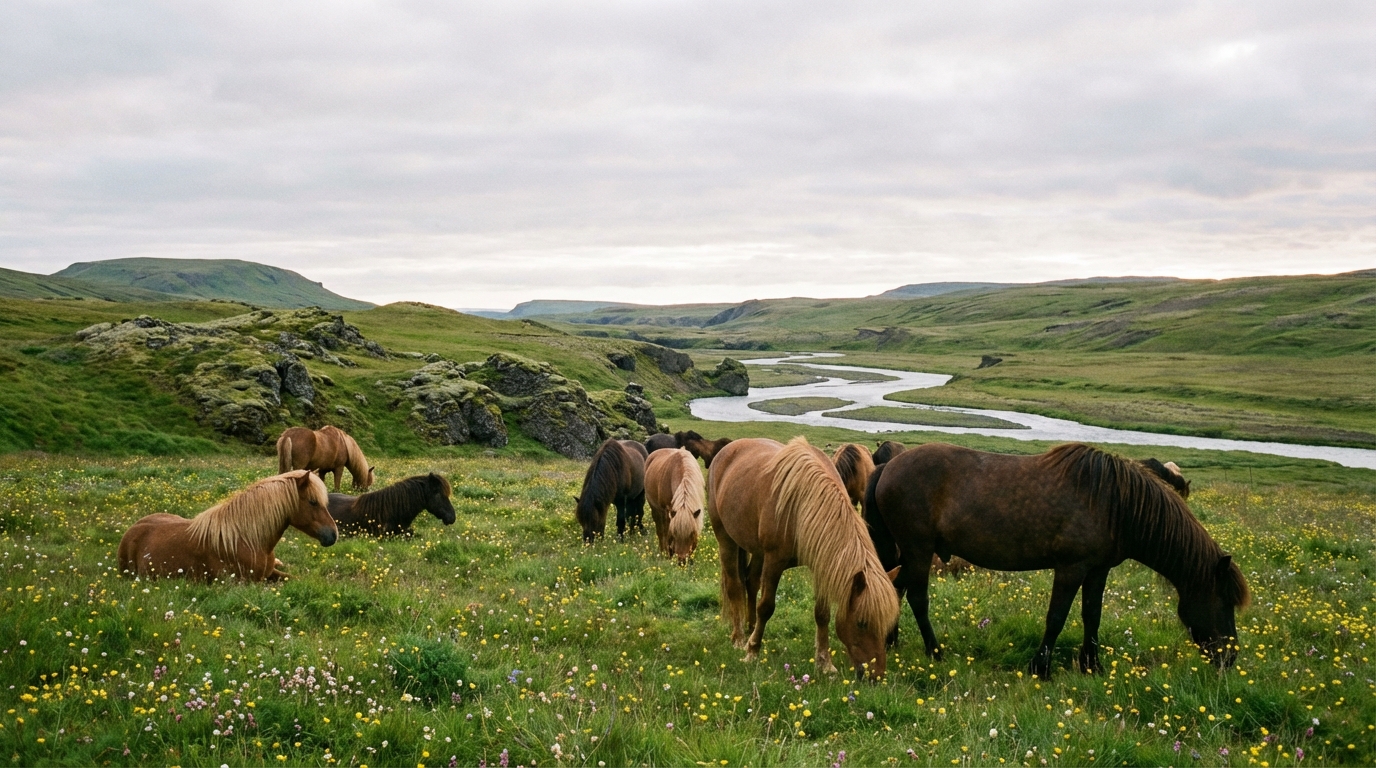
Conventionally, horses find themselves restricted to cramped enclosures. On our land, we've granted them access to nearly everything—to such an extent that an observer might conclude we are the captives, stationed within a modest fenced perimeter near the dwelling while the horses roam freely across the expanse. This single image upends a deeply held belief: that security is primarily a function of walls. Perhaps we humans, too, have mistaken our own enclosures—our routines, our carefully constructed lives—for genuine safety.
1) When "Housing" Is a Viewpoint, Not a Structure
We tend to regard physical shelter as the essential foundation of wellbeing. A larger stall. A superior barn. More elaborate facilities.
Yet when horses are given open terrain, the very concept of home transforms. It ceases to be defined by built environments and becomes instead an embodied sense of security: the freedom to retreat from pressure, to select one's own ground, and to find stillness without constant oversight.
This is precisely why the image of our human enclosure—that small, bounded area—carries such weight. It reveals how readily we mistake confinement for care. Horses require no four walls to assess their safety; they evaluate it through what their surroundings permit them to do. We might ask ourselves: how often do we confuse the structures we build around our own lives with the felt experience of actually being secure?
2) The Safety of Options: Space as an Everyday Permission
Offering the horses most of our acreage is not a grand gesture. It is a quiet, daily act of consent.
When horses have room to disperse, security is no longer concentrated in a single location. It spreads across the landscape: here, a place to stand; there, a place to wander; elsewhere, a place to rest or simply be undisturbed.
This matters profoundly for a relationship without riding or training, because it redefines our role entirely. Rather than organizing the horse's existence into tidy compartments—feed here, wait here, sleep here—we can instead cultivate conditions that allow for continuous, modest decisions. The aim is not to abolish all limits, but to prevent those limits from dominating the horse's inner life. In our own human existence, we might recognize a similar truth: genuine peace often emerges not from the absence of boundaries, but from having enough room within them to choose.
3) Feeding Without the Clock: Calm That Doesn't Depend on a Door
The experience of safety reveals itself most clearly in relation to food.
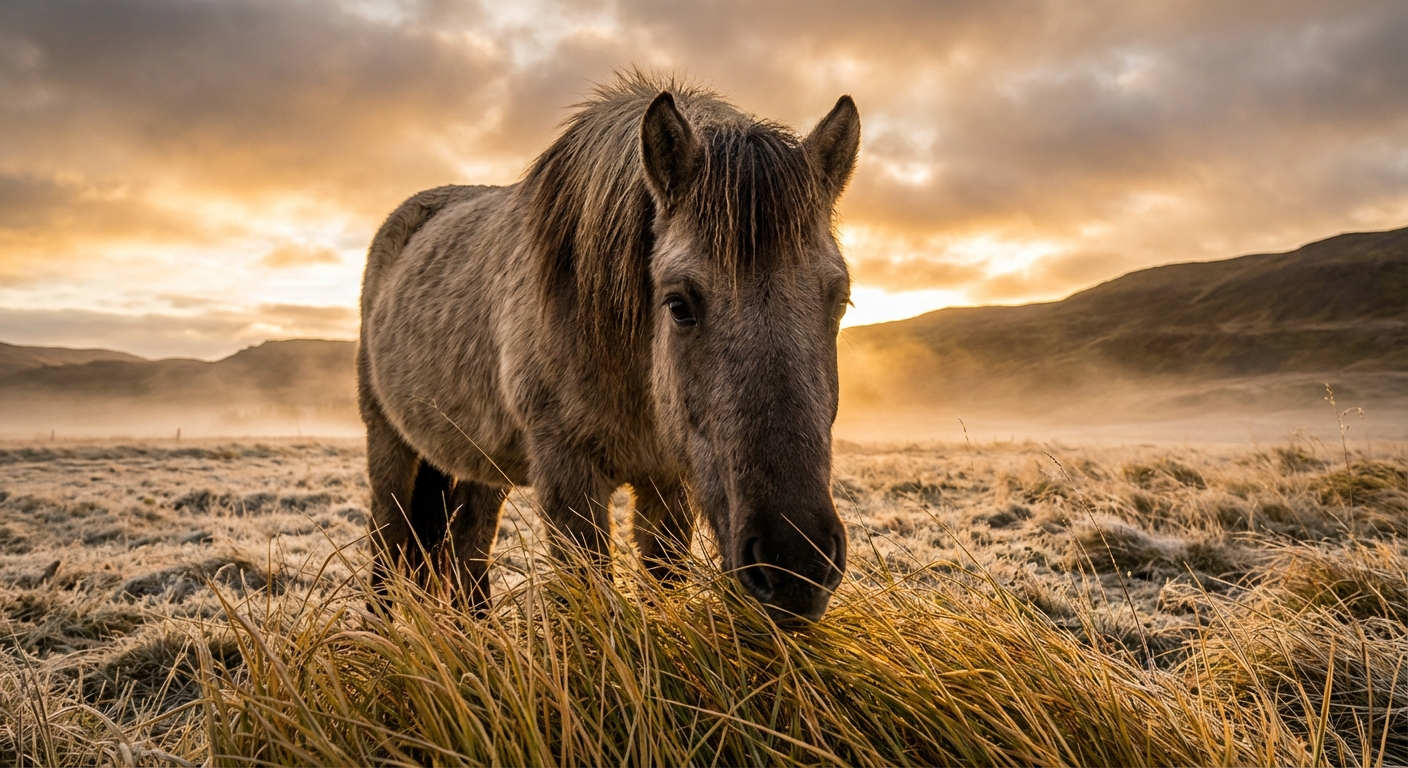
Instead of adhering to rigid feeding schedules, I work to encourage natural grazing behavior wherever possible. The environment offers access to varied hays and foraged herbs, allowing the horses to instinctively seek out the nutrients their bodies require.
This fundamentally alters the practical meaning of shelter. When a horse's day revolves around anticipating the next scheduled meal, even a building can become a site of tension: standing, waiting, listening, bracing for what comes next. But when feeding mimics the rhythms of natural foraging, the emotional atmosphere cools. The horse no longer anchors their sense of security to a single moment—a bucket appearing—or a single threshold—a door swinging open.
Thus, the felt experience of safety is not assembled from timber and shingles; it is woven through access—access to variety, access to movement, access to agency. How many of us have similarly discovered that our own calm depends less on what surrounds us and more on whether we feel genuinely free to move, choose, and nourish ourselves as we need?
4) "We're the Ones Inside": The Human Lesson in Letting Go
The fence beside our home serves as more than a boundary; it functions as a reflection.
It illuminates how instinctively humans position themselves at the center of things: we construct, we oversee, we determine, we organize. And then we pronounce the outcome "secure."
But in an arrangement where the horses possess most of the territory, human authority shrinks visibly. We cannot depend on familiar conveniences—shutting a gate, restricting movement, keeping everything within reach—to manufacture the sensation of control.
Living alongside horses without riding or training demands this kind of humility. It requires us to acknowledge that the horse's tranquility may arise precisely from not being handled, not being directed, not being kept near. Sometimes the most generous thing we can offer is a thoughtfully designed environment—followed by the discipline to stop inserting ourselves into every passing hour. This is a lesson that extends far beyond the paddock: in our closest relationships, too, the deepest gift is often not our presence, but our willingness to step back.
5) The Quiet Power of Variety: Hay, Herbs, and Self-Selection
Offering a range of hays and wild herbs is not merely a nutritional nicety. It is a form of emotional grounding.
When a horse can choose from an array of options, the environment communicates something subtle yet significant: you are not confined to a single possibility. You need not accept one fixed provision at one fixed hour.
This message is integral to felt safety. It diminishes the sensation of being trapped—in body and in mind. The horse is not merely a passive recipient; the horse is an active participant.
And because this is coexistence rather than conditioning, no expectation accompanies the food. The horse need not "earn" access through compliance. The land and its offerings quietly affirm: you are free to simply be a horse here. We humans might recognize this same longing in ourselves—the desire to be nourished without having to perform, to be welcomed without conditions attached.
6) Redefining "Protection": Less Management, More Livability
We easily fall into assuming that protection is something we impose upon horses: placing them in controlled units, delivering resources according to our timetables, maintaining dominion over every variable.
But the reality unfolding at our home points toward a different understanding of protection—one composed of livable circumstances.
- We expanded access to the land so horses are not compressed into confined quarters.
- We structure feeding to support instinctive foraging rather than clock-bound meals.
- We supply diverse hays and wild herbs so horses can select what suits their needs.
Viewed from this perspective, physical structures matter far less than what the horse can actually *experience* each day: space to move, space to choose, space to settle into stillness. Safety ceases to be a building and becomes instead an atmosphere. Perhaps this is the quiet revolution available to all of us: to stop constructing elaborate protections and instead ask what conditions would allow those we care for—and ourselves—to truly breathe.
Equine Notion
https://equinenotion.com/