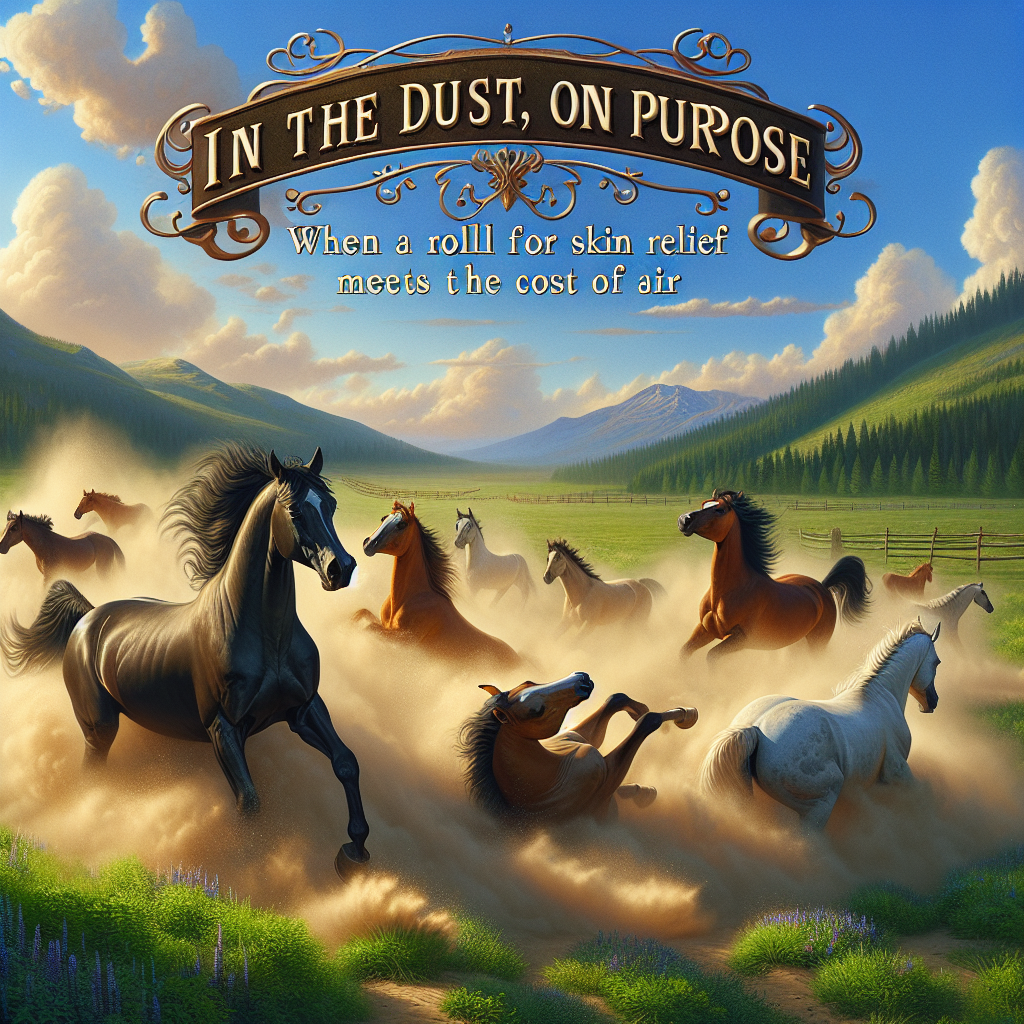
In the Dust, On Purpose: When a Roll for Skin Relief Meets the Cost of Air

Hook
A horse lowers itself to the earth as though it has been anticipating this moment since morning.
Shoulder down first.
A rotation.
A slow, intentional press into parched soil.
From afar, it appears to be pure pleasure—uncomplicated, innocent, whole.
Up close, it can also resemble something more: a choice. Skin relief now, particles in the atmosphere now, and whatever those particles mean for respiration afterward.
This represents one of the most obvious moments where living together emerges without saddles, without lessons, and without demanding a thing. We simply observe. We breathe the same atmosphere. We resist crafting a tidy narrative from a nuanced selection.
1) Dust Bathing as a Visible "Yes"
Dust bathing is frequently misunderstood.
Observers often call it play because it can appear enthusiastic.
Yet it can also be peaceful and systematic.
A horse might come back to an identical location.
They might deliberate carefully about where to lie down.
They might roll with a purpose that seems anything but accidental.
In shared living, the valuable approach is to regard the roll as significant, even when we cannot interpret it precisely. The horse is communicating "this provides relief," through a body that expresses itself in weight, rubbing, and connection with the soil.
That doesn't demand our intervention.
It does demand our attention.
2) The Skin Side of the Tradeoff
When a horse works dust into its hair, something occurs at the exterior.
There is touch.
There is friction.
There is coating.
There is the basic physical truth of applying a dry layer over hide and fur.
Whether the horse seeks soothing, respite, or simply a sensation it prefers, the behavior itself indicates that coat and hide are tools the horse uses to regulate its own state. The horse isn't passively awaiting care. It is acting.
For people who share their lives with horses, this offers a subtle lesson: skin soothing may not appear as we imagine. It may appear as becoming filthy intentionally.
And it may appear as selecting the dirt even when we would prefer to select tidiness.
3) The Air Side We Can't Ignore
Dust doesn't remain earthbound.
It lingers.
It floats.
It reaches nostrils.
It becomes communal.
A dust bath can momentarily alter the atmosphere surrounding the horse—and surrounding anyone in the vicinity. Even without specifying health consequences or reaching firm verdicts, we can recognize a fundamental friction: what settles on hide can also travel into lungs.
Living together means accepting that friction without converting it into doctrine.
Not "dust causes harm."
Not "dust poses no problem."
Simply: this instant provides benefit one way, and it may extract a price another.
That's a more truthful perspective than acting as though only one advantage exists.
4) What Non-Intervention Actually Looks Like
Choosing not to intervene doesn't mean choosing not to care.
It means remaining outside the horse's decision while the horse is obviously making one.
It can appear as allowing the roll its territory.
It can appear as not pushing in with a phone.
It can appear as not chasing a horse upright mid-roll because the coat will get soiled.
It can also appear as our own willingness to retreat.
If the atmosphere grows dense briefly, we can relocate.
We can allow the horse space to complete the act.
We can cease using our respiratory systems as the standard for what the horse may be permitted to do.
This is living together as self-control: allowing the horse to finish its own minor upkeep ceremonies without our preferences becoming a prohibition.
5) Reading the Choice Without Turning It Into a Diagnosis
There's an urge to explain every roll.
To determine what it "signifies."
To categorize it as restlessness, irritation, routine, or something more serious.
But sharing life with horses calls for a different ability: describing without excessive analysis.
You can observe trends without asserting knowledge.
You can observe vigor.
You can observe regularity.
You can observe whether the horse appears calm afterward.
You can observe how the horse departs from the dusty area and resumes its routine.
That style of watching honors the horse's autonomy and keeps us realistic. It also prevents us from constructing narratives we cannot justify.
6) Sharing Space Where Both Needs Exist
The dust bath illuminates a central difficulty of communal existence: one creature's comfort can generate another creature's discomfort.
The horse selects the roll.
The dust rises into the common atmosphere.
A person standing nearby experiences the cloud and must choose a response.
Living together isn't about prevailing in that instant.
It's about creating space for it.
The most basic approach is spatial: avoid positioning yourself in the dust plume.
The more profound approach is emotional: avoid penalizing the horse for choosing comfort in a manner that appears untidy.
If we can permit that modest act—soil as self-maintenance, even when it carries a drawback—we exercise a form of regard that requires no touch, no management, or any purpose whatsoever.
Equine Notion
https://equinenotion.com/