Long Strands, Long Minutes: Coexisting With the Chew That Holds a Horse Together

Time as a Nutrient
We often speak of forage in purely material terms: hay, pasture, sufficient caloric intake. Yet a horse does not merely consume substances—a horse consumes the passage of time itself.
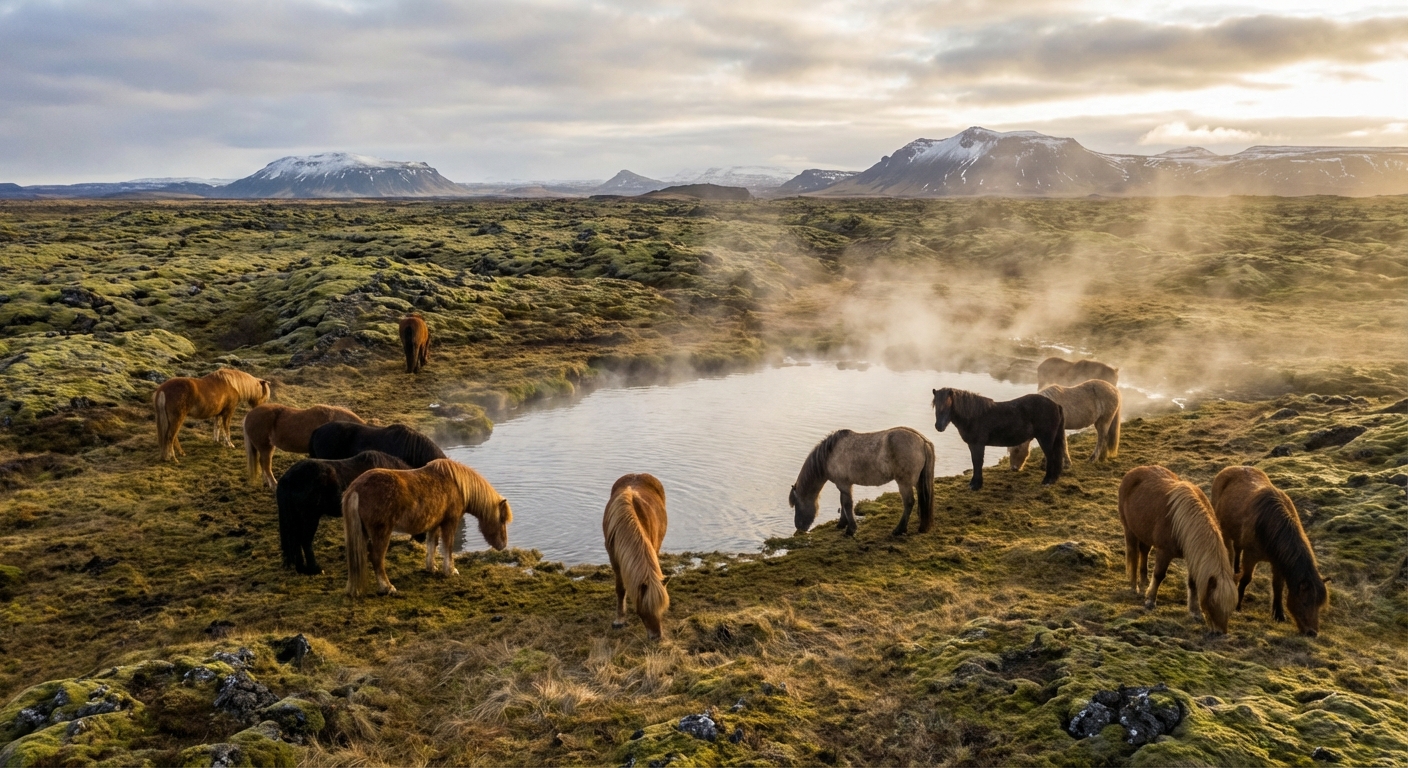
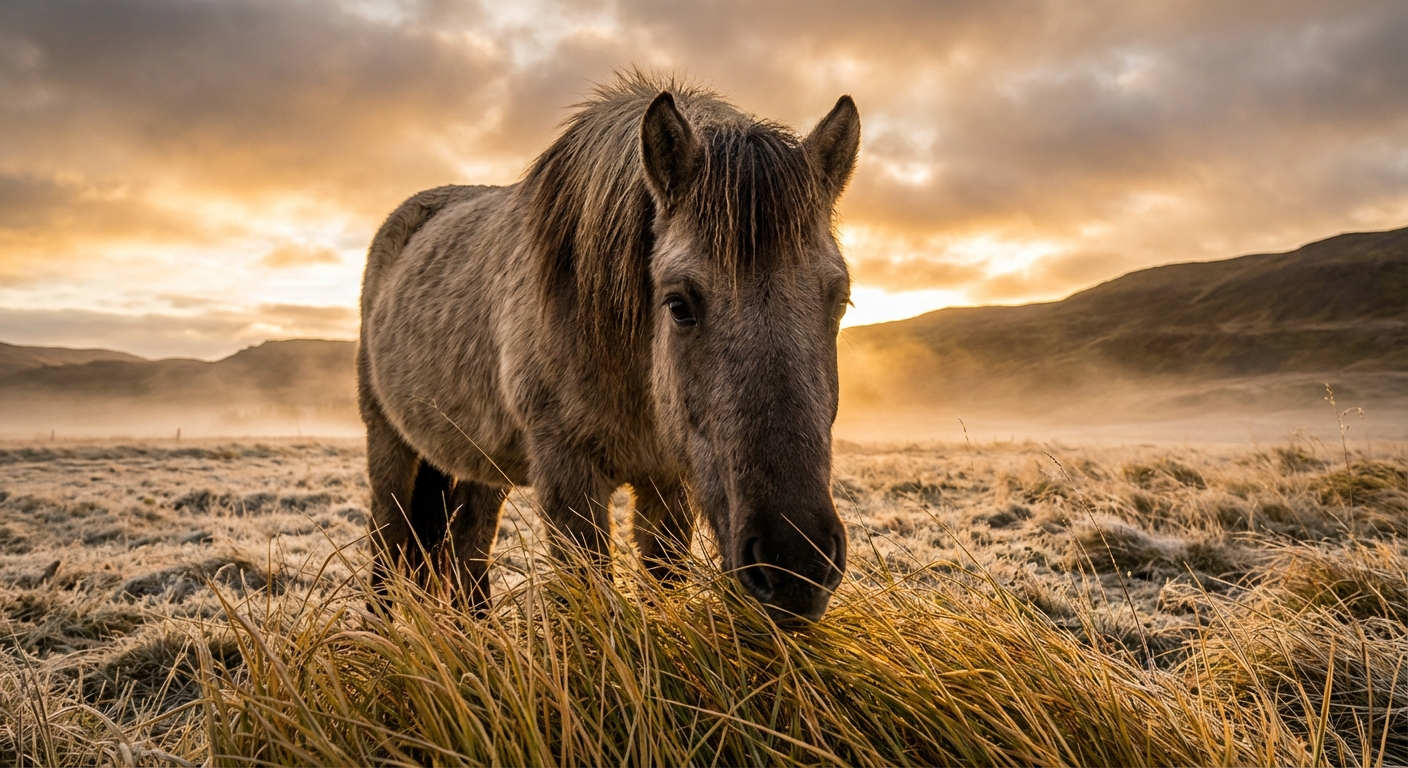
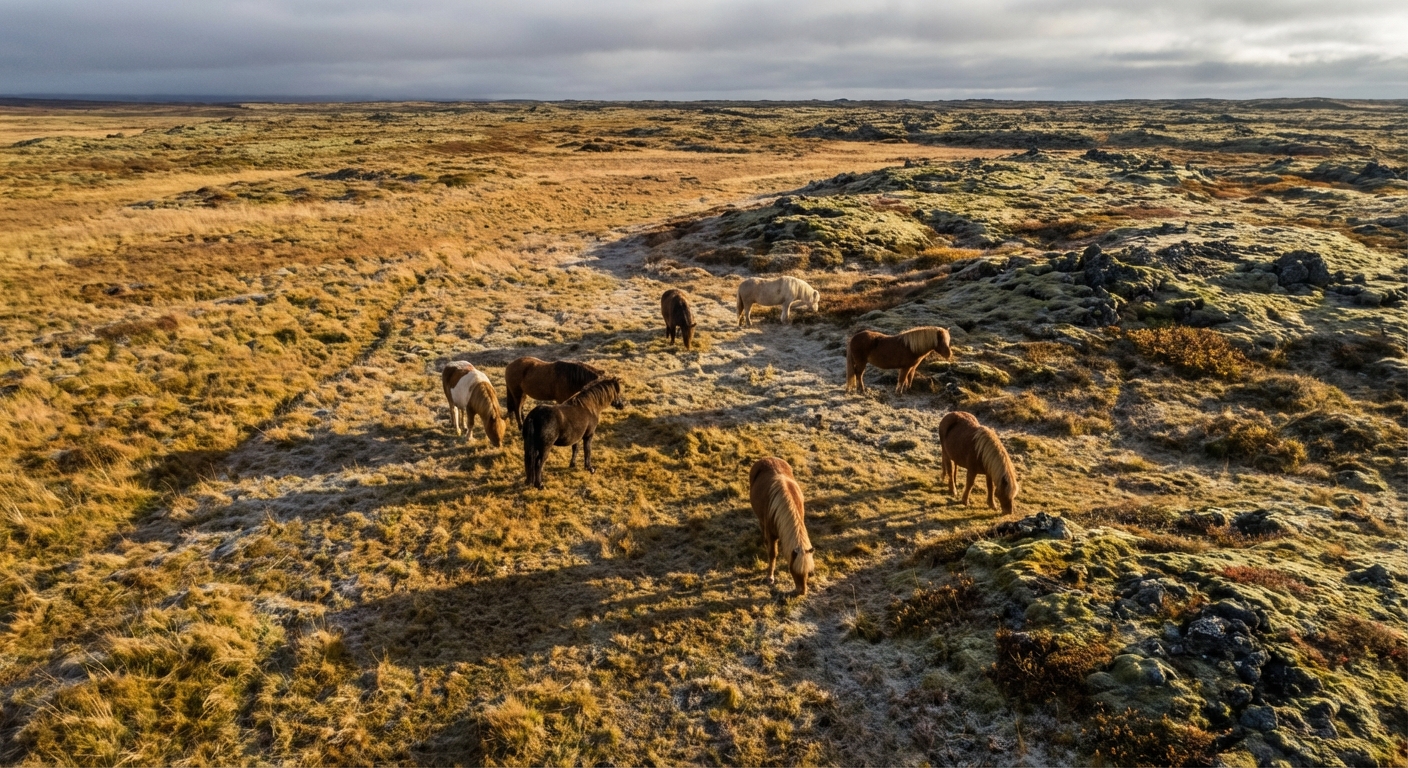
Observe a herd when nourishment is simply there—when they are neither anticipating it, seeking it, nor being pulled away from it. The distinction becomes visible between feeding that satisfies the stomach and feeding that occupies the soul of the day. The muzzle returns again and again to the earth. The body continues its gentle forward drift. The mind settles into an engagement that resembles something close to stillness.
Here, the duration of mastication reveals itself as far more than incidental. It functions as a temporal architecture. When the jaw is permitted to labor through extended periods, the whole day organizes itself around that rhythmic endeavor. When chewing is truncated—by interruptions, by haste, by anything that transforms eating into a discrete event—the horse must find some other occupation for hours that evolution designed for a different purpose.
We might recognize this rhythm in ourselves: how the steady, unhurried activities that anchor our days—the morning rituals, the contemplative walks—give structure to everything else, and how their absence leaves us searching for something to fill the void.
Fiber Length and the Shape of the Day
Within a coexistence framework, the length of fiber matters less as a scientific technicality and more as something witnessed through careful attention. Various forages demand different kinds of labor from the horse. Certain mouthfuls require extended processing; others do not. Some keep the animal engaged, drawing them back repeatedly for the next bite, while other offerings vanish swiftly and leave the horse standing—still hungry for occupation but with nowhere to direct that need.
This is not an argument for making feeding unnecessarily complex. Rather, it is an invitation to attend to duration. When you alter a forage and the herd suddenly finishes earlier, stands idle earlier, begins searching earlier—you have not merely changed their food. You have altered how much of their waking life is devoted to the central, grounding activity their species was built around.
And because horses move naturally as they graze, the time spent chewing is simultaneously time spent in motion. When the mouth works in an unhurried cadence, the hooves tend to follow in an equally unhurried cadence. When eating becomes condensed, locomotion often condenses alongside it—regardless of our intentions.
So too with human beings: when we compress our meals into efficient transactions, we often compress the gentle movement and presence that once accompanied them, losing something essential we cannot quite name.
The Acid Clock We Don't See
The equine stomach produces gastric acid without pause. This single biological truth reorients the entire ethics of feeding. Uninterrupted access to forage becomes not an indulgence but a baseline requirement for welfare.
The moment eating ceases, an invisible countdown begins—quietly, without fanfare. Whether the interruption stems from travel, a medical procedure, a scheduling decision, or the well-intentioned belief that "they've already been fed"—the body continues its relentless production.
This is where the duration of chewing connects most directly to digestive reality: the concern is not solely how much enters the system, but how long the act of consumption can persist without being severed. The human responsibility transforms from "providing meals to the horse" to "ensuring nourishment remains perpetually accessible."
Viewed through this lens, fiber length ceases to be a minor preference. It becomes integral to whether a horse can sustain the one activity that shields them from prolonged, unprotected emptiness.
There is wisdom here for our own lives: our bodies, too, carry invisible clocks—processes that continue whether we attend to them or not—and genuine care means designing our days around these rhythms rather than against them.
What Behavior Says When Chewing Gets Shortened
Repetitive, stereotypic behaviors serve as environmental diagnostics. When a horse's day is stripped of the extended, rhythmic, anchoring work of foraging, the horse does not passively surrender those vacant hours. They find ways to populate them.
Sometimes this filling manifests as restlessness. Sometimes it appears as a stillness that bears no resemblance to genuine rest—for standing motionless in a stall through the night is not recuperation; it is the enforced prevention of what the body insists upon doing. Sometimes it emerges as social friction we mistakenly attribute to temperament. We construct simple narratives—identifying the "dominant" one, the "leader"—while overlooking the more fundamental pressure: the day has been constricted.
Life within a herd is typically negotiated without conflict. Which individual defers around a particular resource may shift depending on what that resource is and how scarce it feels. When forage flows abundantly and continuously, the collective often resembles less a competition than a constellation of individual preferences. When access becomes restricted—by feeding windows, by disruptions, by meals that evaporate rapidly—minor negotiations can calcify into tensions.
Understood this way, chewing time extends beyond digestion. It becomes a matter of social harmony.
Humans, too, grow fractious when deprived of their grounding activities—when the day tightens around us, we often blame each other for tensions that originate in the architecture of our time.
Coexistence: Arrange the World, Then Get Out of the Way
A practical philosophy of coexistence begins with an inversion: grazing is not an activity slotted into the day; it is the bedrock upon which the entire day is constructed. The question, therefore, is not "How do I schedule feeding?" but rather "What allows eating to continue unbroken so that the horse's internal rhythm is never left adrift?"
This means paying attention to actual grazing duration among your own animals. It means recording what shifts when routines are disturbed—because the consequences may surface later as altered mood, interpersonal conflict, or a body that seems mysteriously ill at ease. It means factoring the silent clock of acid damage into every management choice that pauses consumption.
And it means acknowledging that much of what we label "care" is actually compensation. When a horse cannot move and chew throughout the day as their design intends, we find ourselves attempting to substitute for that lost self-regulation with additional apparatus, additional interventions, additional justifications.
Fiber length, chewing duration, digestion—these are not distinct subjects. They constitute one extended, gradual activity that a horse is meant to perform across the arc of the day, drifting gently forward, in the company of others, with sustenance that never abruptly disappears.
Perhaps the deepest teaching here is for us: that care, at its truest, is not the multiplication of interventions but the patient arrangement of conditions that allow another being—horse or human—to simply be what they are.
Equine Notion
https://equinenotion.com/